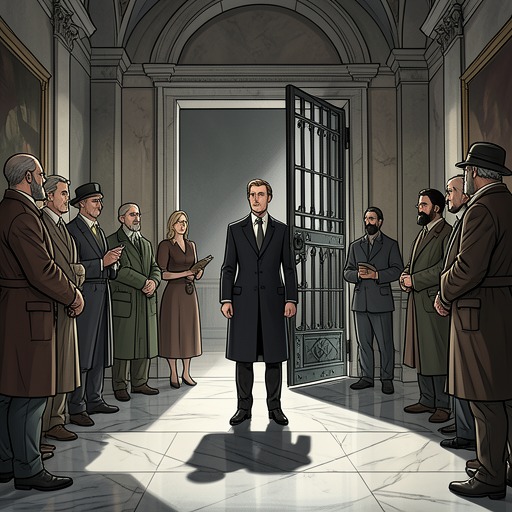
Herzoslovakian royal massacre and proclamation of the republic
The Secret of ChimneysThe Herzoslovakian royal massacre and proclamation of the republic was the revolutionary break that ended the rule of King Nicholas IV and Queen Varaga. The uprising established a republic, but it did not extinguish monarchist politics: the old dynasty’s succession claims and the possibility of restoration continued to shape later negotiations and rivalries.
Background and Causes
King Nicholas IV’s marriage to Queen Varaga was presented as a breach of the country’s expectations of royal legitimacy. Varaga had been a Paris music-hall performer, and her claimed Romanov descent was treated as fabricated; nevertheless, Nicholas married her at the cathedral in Ekarest and had her crowned. He secured the support of his ministers, but the account stresses that this did not win over the population, described as aristocratic and reactionary and attached to the idea of a genuine royal lineage.
Discontent followed, alongside what Anthony Cade calls ruthless suppression. The conflict culminated in an uprising against the monarchy. The account links the royal couple’s contested legitimacy to popular opposition, but also places their deaths within the broader escalation from unrest to revolution rather than presenting the marriage alone as a complete explanation.
The Uprising and Republic
The uprising stormed the palace, killed King Nicholas IV and Queen Varaga, and proclaimed a republic. This was both a violent end to the reigning royal household and a formal change of political order. The republic persisted after the revolution, though the country remained politically turbulent; Cade remarks that presidents had also been assassinated in the ensuing period.
The event is recounted retrospectively in conversation rather than staged as a present-tense battle scene. Its compressed telling moves from the disputed marriage, through public discontent and suppression, to the palace uprising and the proclamation of a new regime. That sequence gives the massacre its double significance: it closes the royal reign and establishes the political framework against which later restoration efforts must contend.
Aftermath and Restoration Politics
The republic did not make the monarchy irrelevant. Years later, supporters in Herzoslovakia were prepared to restore it and offer the crown to Prince Michael. The British government supported that prospect, while Michael was prepared to grant concessions to Isaacstein and Co in return for a substantial loan to place him on the throne. The proposed restoration thus joined dynastic claims to foreign political support and financial arrangements.
Michael’s murder then made succession an immediate question. Superintendent Battle identifies Prince Nicholas Obolovitch, Michael’s first cousin, as the next heir. The earlier revolution had removed one king and queen, but the subsequent political contest still turned on hereditary legitimacy and which claimant could plausibly occupy the throne.
Nicholas and the Unresolved Legacy
Prince Nicholas was believed to be in the United States, raising money on his expectations; Isaacstein, however, thought he had been killed in the Congo. Nicholas later explains that the report of his death was one he himself had spread. He had promised Isaacstein a prince and revealed that he was Nicholas Sergius Alexander Ferdinand Obolovitch, living under the name Anthony Cade.
That revelation does not undo the republic or erase the royal massacre. Instead, it shows how the revolution’s unresolved succession continued to organize the present: the identity and presumed absence of the heir mattered to the financing of restoration, and Nicholas’s return transformed a supposedly dead claimant into a living participant in the political bargain. The massacre’s lasting consequence is therefore not only the replacement of monarchy by republic, but the survival of dynastic claims as a source of renewed political possibility.